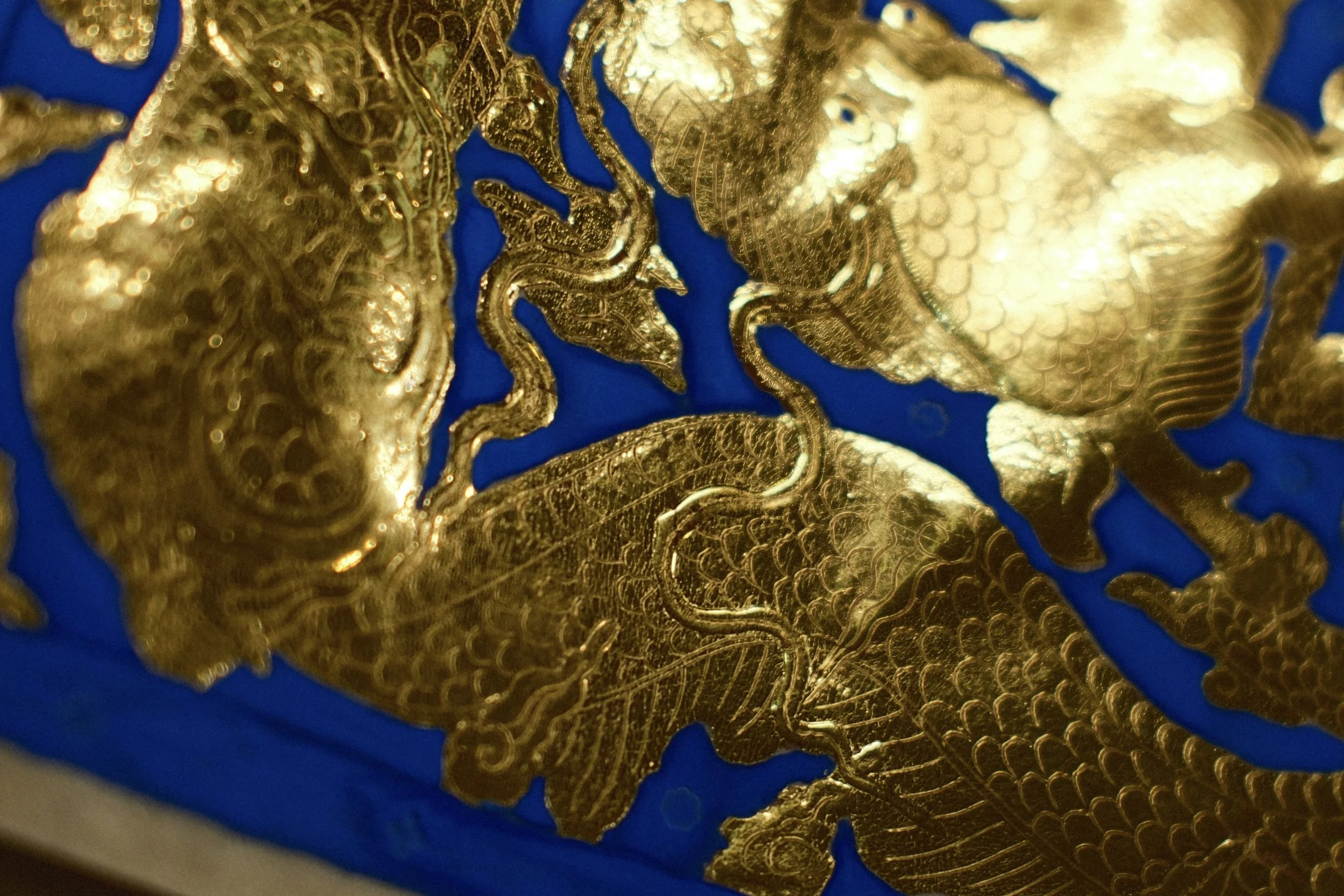
This October, I’ll be teaching two gilding workshops in New York City, one focusing on modern materials and the other on traditional materials. Each workshop will run for three days, from 9:00 AM to 4:00 PM each day.
These will be quite intensive gilding workshops, but I’m confident that everyone will walk away with a beautiful piece of work created with genuine gold leaf!
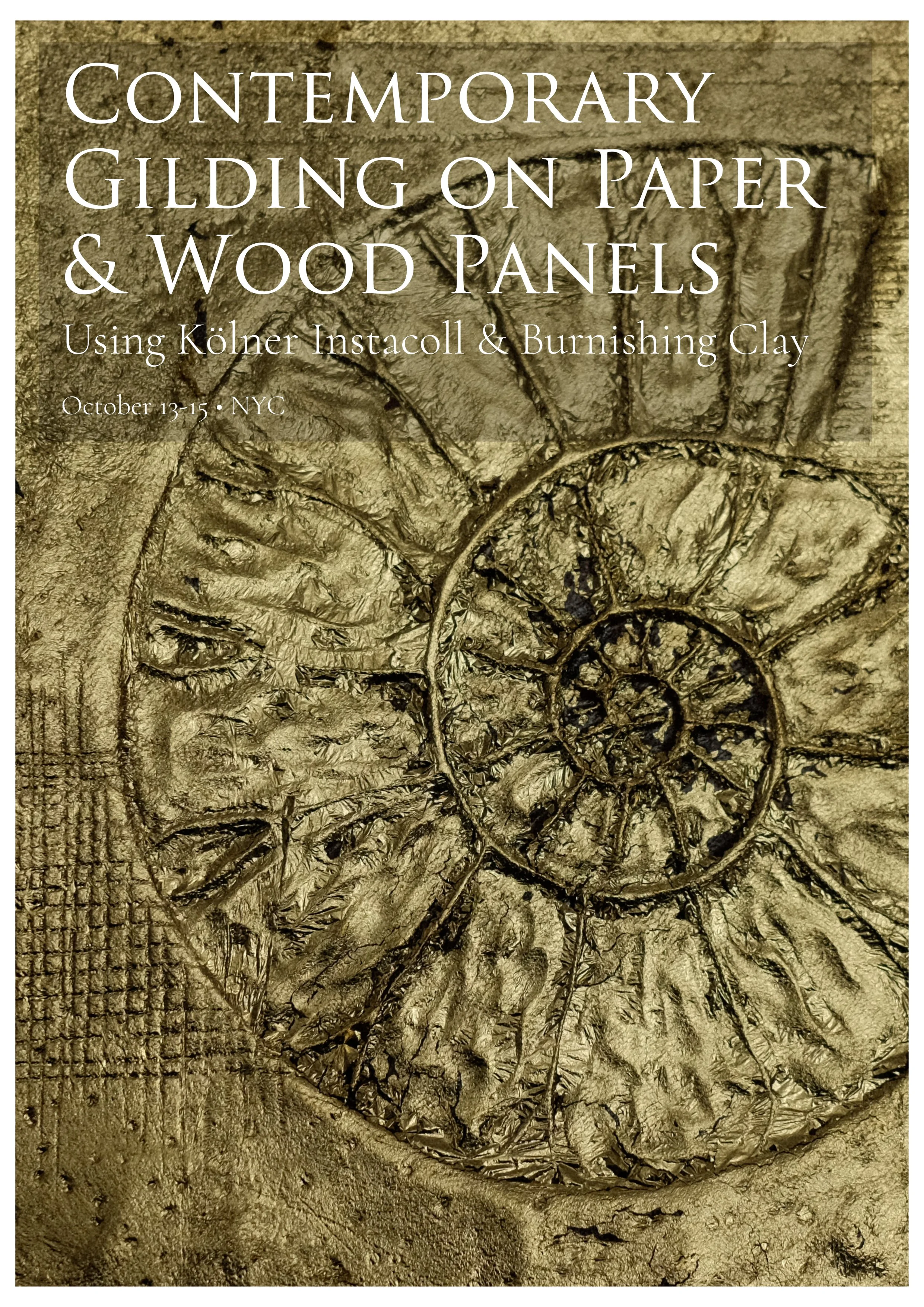
Contemporary Gilding on Paper & Wood Panels: Using Kolner Instacoll & Burnishing Clay
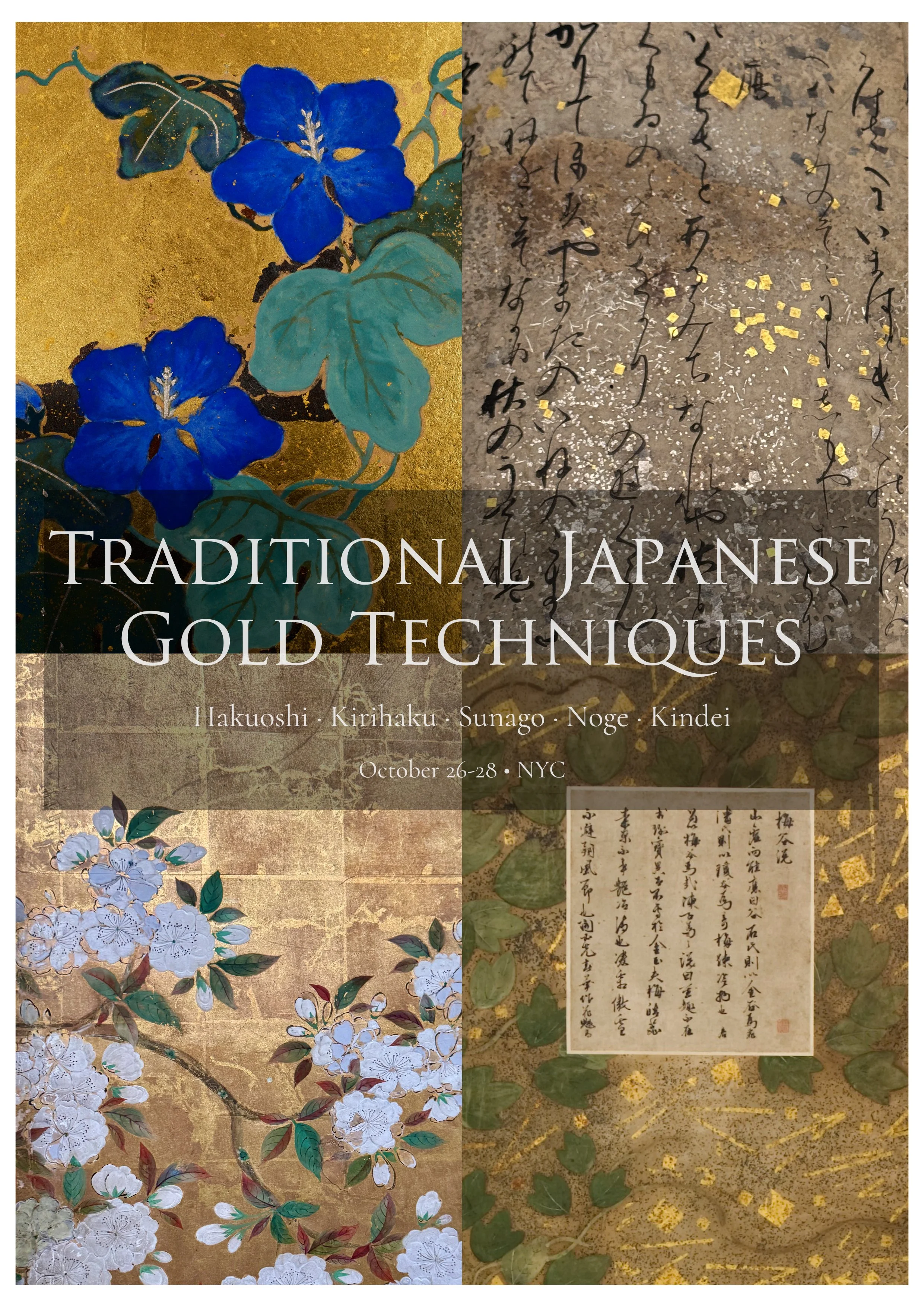
Traditional Japanese Gold Techniques
October 13-15
Location: Sepp Leaf Products, 381 Park Ave S. Rm. #1301, NY
Maximum 7 students
Purchase Material Kit CLICK HERE
Use code “hoangdao” when check-out to get class discount
October 26-28
Location: Sepp Leaf Products, 381 Park Ave S. Rm. #1301, NY
Maximum 7 students
Purchase Material Kit CLICK HERE
Use code “hoangdao” when check-out to get class discount
Material list
Instacoll High Gloss Clear or Yellow
Instacoll Activator
Kolner KGGG Fond Burnishing Clay WHITE and/or RED
Kolner KGGG Colnasol or Kolner Colnafix
Kolner KGGG Sealer
Gilding supplies: 23K gold leaf or silver leaf (1 book each), gilder’s knife, gold cushion & gilder’s tips, agate burnishers dog tooth shape and flat shape
Thorn tip (optional)
3/4” synthetic brush
01 and/or 02 synthetic pointed brush
Talc powder
Kolner burnishing tissues
Provided materials (material fee included in registration fee)
05 Wood panels for mounting paper/parchment and wood panel for gilding
Pergamenata parchment paper and/or watercolor paper
Bamboo tweezers
At the heart of this workshop are two innovative materials developed by Kölner. Instacoll is a water-based gilding system designed to produce durable, high-gloss mirror gilding on a wide range of surfaces. Burnishing Clay is a modern polishing ground that creates an exceptionally smooth surface for burnished gold while allowing greater creative flexibility than traditional gesso and bole. Used individually or in combination, these materials bridge traditional craftsmanship with contemporary possibilities, enabling artists to achieve finishes that are both technically reliable and visually distinctive.
While traditional water gilding remains one of the most beautiful historic techniques, it often presents challenges in tropical and humid climates, where fluctuations in temperature and humidity can lead to cracking, delamination, or long-term instability. Kölner's contemporary materials provide a reliable alternative while preserving the brilliance and elegance of traditional mirror gilding.
One of the unique aspects of my approach is the combination of Kölner Instacoll and Burnishing Clay within the same artwork. By selectively using both systems, I can create visual effects and transitions that are difficult or even impossible to achieve with traditional gesso and bole alone. This hybrid method opens new creative possibilities while maintaining exceptional surface quality.
My exploration of these techniques has also been deeply inspired by Japanese Buddhist painting (Butsuga) and iconography. Studying the sophisticated use of gold in sacred artworks encouraged me to rethink how contemporary materials can be used to expand the expressive language of gilding. Rather than replacing traditional methods, I see these innovations as a way to build upon historical knowledge and develop new artistic possibilities for today's practitioners.
In this three-day workshop, we will learn how to create a flawless, high-gloss gold finish with Kölner Instacoll and Burnishing Clay, as well as how to build raised decorative reliefs using Kölner products, and to carve down patterns into materials to add depth and brilliance to the work. The workshop covers gilding on both paper (or parchment) and wood panels, highlighting the different surface preparation and application methods required for each material.
3-Day Workshop Activities
Day 1 — Preparing the Gilding Ground
We will begin by learning how to prepare the surface for gilding, including how to mount and stretch parchment onto a wood panel, as well as how to apply Burnishing Clay and Kölner Instacoll as modern alternatives to traditional gesso.
We will also address some of the most common challenges encountered during gilding, such as preventing and repairing air bubbles, achieving a smooth and even application, and preventing wrinkles and other surface imperfections in different materials.
Day 2 — Refining the Surface & First Layer of Gold
On the second day, we will learn how to refine and prepare the surface for gilding. This will include smoothing the surface, carving into it, and building up additional material to create raised decorative patterns.
Once the surface is properly prepared, we will apply the first layer of gold leaf and allow it to set overnight.
Day 3 — Layering, Burnishing & Surface Effects
On the final day, we will continue with the second and, if necessary, third layers of gold leaf.
We will then explore different ways of finishing and manipulating the gilded surface, including achieving a highly polished mirror finish, creating decorative patterns with specialized tools, and combining mirror-polished and matte surfaces to create contrast and depth.
Over the three days, I hope that we will be able to complete the following pieces:
01 piece of perfectly mirror-polished gilding — a particularly challenging task!
01 piece of gilding with raised decorative patterns
01 piece of gilding with recessed/carved decorative patterns
01 piece of gilding on parchment
01 piece on parchment combining raised and flat decorative patterns for contrasting textures and finishes
Material list
Japanese gold leaf 22K or 23K (20-30 leaves)
Silver leaf (20 leaves)
Color silver leaves (blue, red,…) (5 leaves)
Talc powder
Agate burnisher
Provided Material (material fee included in registration fee)
Bamboo tweezers
Sunago Bamboo tubes
Bamboo knives
Materials to make gold leaf cushion
Imitation gold powder (Kindei) made of brass
Mounted paper panel
Nikawa (animal glue)
Dosa (sizing liquid)
Flat brush & pointed brushes
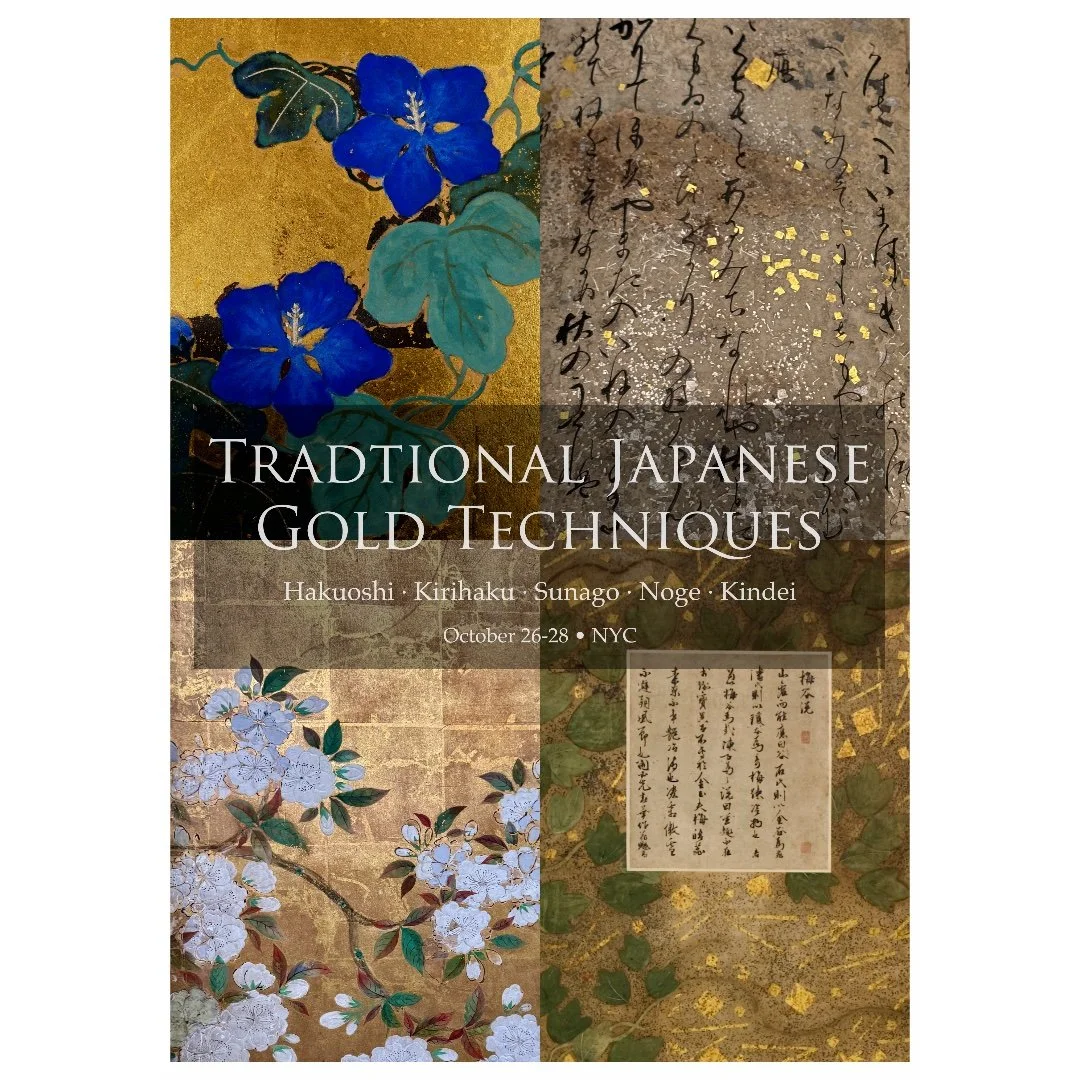
During the Meiji Restoration of the 1870s, Western painting techniques rapidly entered Japan, prompting artists and scholars to distinguish traditional Japanese painting from the newly introduced European styles. The term Nihonga (日本画, “Japanese painting”) emerged to describe works rooted in native aesthetics and materials. While Western painting often embraced oil on canvas with subjects such as religious narratives, still life, landscapes, and portraiture, Nihonga developed through the use of mineral pigments on washi paper or silk, depicting Buddhist imagery, seasonal flowers, birds, landscapes, and idealized figures in harmony with Japanese artistic traditions.
Among the many schools that shaped Nihonga, the Rinpa School stands out for its elegant compositions, bold decorative design, and masterful use of gold and silver leaf. Artists such as Tawaraya Sōtatsu and Ogata Kōrin transformed natural motifs into poetic visual rhythms, where metallic surfaces became an integral part of the composition rather than mere ornamentation. Their work continues to inspire contemporary artists working across painting, lacquer, calligraphy, and decorative arts.
This three-day workshop introduces the principal traditional gold techniques used in Japanese painting. Participants will learn the fundamental methods of working with gold/silver leaf and powder, and their historical applications and contemporary possibilities.
The workshop covers the following core techniques:
Hakuoshi (Gold Leaf Application): Preparing the surface and applying gold leaf to achieve clean, luminous finishes.
Kirihaku: Cutting and applying finely shaped pieces of gold leaf to create decorative patterns and refined surface details.
Sunago: Creating scattered gold effects with fine gold flakes to add texture, atmosphere, and visual depth.
Noge: Applying delicate gold strips and lines to produce elegant linear ornamentation.
Kindei: Preparing and painting with gold powder to create intricate details, highlights, and expressive brushwork.
3-Day Workshop Activities
Day 1 — Making Traditional Tools
I always dedicate the first day to learning how to make traditional tools from bamboo and deer leather. I believe this is an essential part of the process, as it allows you to develop a deeper understanding of natural materials and how they interact with gold leaf.
Day 2 — Noge, Kirihaku & Hakuoshi
On the second day, we will learn how to cut gold leaf into fine threads (noge) and geometric pieces (kirihaku). The cutting techniques used here are completely different from those used in traditional Kirikane.
We will then learn hakuoshi — the technique of applying gold leaf to achieve an exceptionally flat and seamless gilded surface on paper that has been mounted onto a wooden panel.
Day 3 — Kindei & Sunago
On the final day, we will explore kindei (gold powder) and sunago (gold flakes), beginning with the process of grinding gold leaf into the desired particle size.
We will learn how to hand-polish the gold both before and after application, and how to sprinkle the gold delicately and intentionally to achieve precise control over the final texture and visual effect.
By the end of the three-day workshop, my goal is for each participant to complete 3–5 pieces of paper mounted onto wooden panels, incorporating the full range of traditional techniques covered throughout the workshop.